CougsFirst!: A Non-Profit Backend built around the team
Kelsey wasn’t sold on Notion until she saw it working in the language of a business like hers. What began as help connecting CougsFirst!’s partnerships and deliverables grew into an ongoing systems partnership spanning board collaboration, team workflows, event operations, AI, and the strategy for what comes next.
First, she needed to see it
Kelsey Larsen—the newly-appointed Executive Director of CougsFirst!—didn’t need someone to tell her that Notion could organize information. She needed to see what that actually meant for the kind of work she was doing.
What changed her mind was a friend with a similar business model showing her a dashboard. Then, on an accountability call, other community friends showed her how they were using it, too.
She could see it in their language. Their work. Their actual businesses.
By our December 2025 consultation, her reaction was: “I'm mad I didn't do it sooner.”
But seeing the possibility and building the system were different things.
Kelsey had started experimenting on her own. She’d uploaded partnership agreements, organized deliverables, and begun linking commitments to events. Some of it was already clicking. She could see what CougsFirst! owed a partner, what that partner owed the organization, and which event a commitment belonged to.
The rest was harder. She was working with years of existing information while building new processes at the same time. A template designed for someone else’s business wasn’t going to hold all of that without some thought.
She didn’t come to me with a blank page. She came with a starting point, a lot of operational knowledge, and a clear sense of where she’d reached the edge of what she could confidently build herself.
The problem wasn’t a lack of information
As CougsFirst!’s Executive Director, Kelsey was working across memberships, sponsorships, longer-term partnerships, events, board responsibilities, and the people carrying those things out.
Those weren’t independent lists.
A partner might have an agreement covering several events. One of those commitments might include a booth, a sign, a newsletter feature, or another visibility opportunity. A business could be a member and also sponsor something specific. The team needed to know what was available to sell, what had been promised, and what needed to happen next.
The information existed. The challenge was connecting it to action without making someone reconstruct the whole relationship every time. That came through especially clearly during our March VIP Day (the kickoff to our work together). Kelsey talked about the value of the meetings she was having, then said:
“But I don't know how to turn that into action. But I knew Notion could. I just didn't know how.”
That was the work underneath the build. A conversation, an agreement, or a decision needed somewhere to go next. Somewhere it could become an actual task, with context and a person responsible for it.
Turning commitments into work the team could see
The first phase focused on connecting those pieces.
We consolidated deliverables and action items into a shared task database rather than keeping separate lists that were difficult to see together. The work could then appear in different contexts: on a partnership page, alongside an event, or in someone’s own task view.
That mattered because the same task could be relevant in several places without needing to be entered several times.
We also refined the partnership pages themselves. Contact details and agreement end dates needed to be easy to find. Notes, meetings, and action items needed a clearer place. Overview and financial views needed to show different information rather than ask someone to scroll through everything at once.
Sponsorship tracking had its own practical questions. What did the package include? Which event did it belong to? Which business had taken it? What was still available?
We linked sponsors and partnerships, added clearer tier and event references, and created a view of sponsorship availability. The point was to connect the relationship to the specific opportunity and the work that came with it.
We also introduced AI-supported extraction of action items from meeting transcripts. Tasks stayed linked to the meeting they came from, and a “To Assign” view gave unassigned work a visible home.
That changed the structure of follow-through. The meeting record wasn’t just something to look back at. It could feed the work that needed to happen afterward.
The board didn’t need the whole backend
One of the important questions was how to bring the board into the system without giving everyone an overwhelming view of the entire operation.
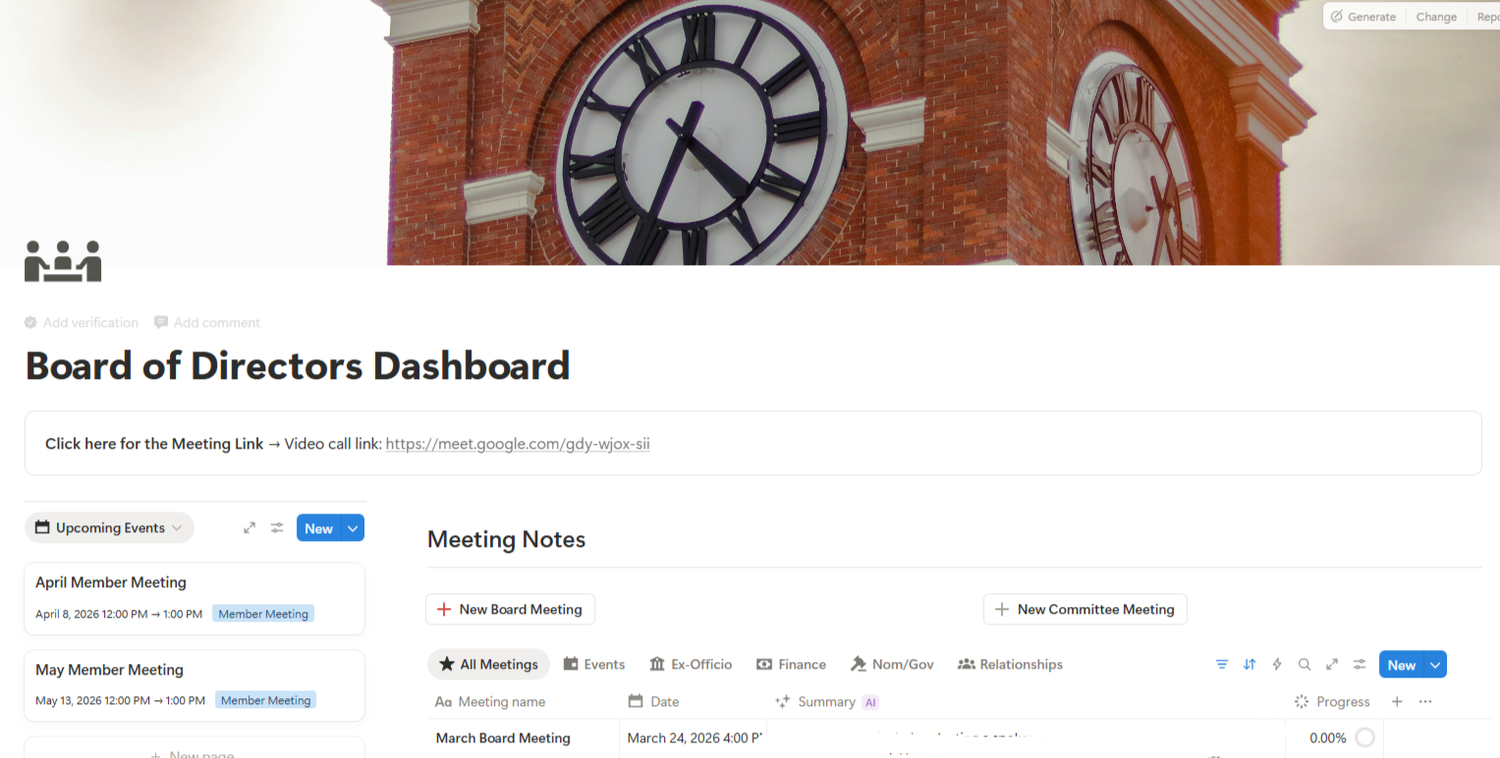
We built a Board of Directors dashboard with the information relevant to that role: board contacts, roles and responsibilities, committee meetings, upcoming events, and assigned tasks.
Committee-specific meeting templates made the different groups easier to organize. A dynamic “My Tasks” view meant each person could see their own assignments. Meeting progress could be viewed without opening every action item individually.
The training plan was intentionally focused. Board members needed to find the meeting notes, see their tasks, and know what was coming up. They didn’t need to become Notion builders to participate.
That distinction kept coming up throughout the engagement. Shared information didn’t have to mean an identical experience for every person using it.
Making it work for the Team, not just for Kelsey
Kelsey could see the potential. That didn’t mean the full workspace automatically made sense to everyone else.
Their Membership Manager & Special Events Coordinator was used to organizing work in notebooks by subject. She wanted digital reminders, but the task views still needed to feel clearer and more manageable.
So we worked with that, rather than treating it as something she needed to get over.
We made her personal page easier to reach. We reduced the number of tasks displayed at once, sorted by due date, and grouped work to reflect the way she already compartmentalized it. Unassigned or undated tasks had a place where they could be reviewed instead of disappearing into the larger list.
We also brought an After Hours event checklist from OneNote into the task database during the session, turning the existing checklist into tasks she could organize and date.
These were small changes compared with the larger architecture. But they were part of making that architecture usable.
A system can be technically connected and still be too much to look at. The training and refinement weren’t extras after the “real” work. They were part of the work.
From an intensive to an implementation partnership
The original proposal was for a VIP Day. As the work developed, the need became bigger than a discrete build.
CougsFirst! needed continuity: someone who understood the organization, could help implement the next layer, and could respond as the team started using it. Kelsey also wanted to avoid taking every individual adjustment back to the board as a separate project.
That became a Phase 2 implementation partnership with build and adoption support through the end of 2026.
And part of that next phase was simplifying.
As more information and ideas had been added, redundant databases and nested pages had made the system harder to trust and navigate. We came back to three central records: Businesses, Events, and Offers/Sponsorships, with tailored views around them.
We clarified offer inclusions, connected offers directly to events, and separated East Side and West Side offers where pricing differed. Assigning an offer to a business could trigger a “Send Invoice” task for operations.
We refined the dashboards with tabs, clearer task priorities, and simpler completion controls. A public-facing upcoming-events gallery was also built during a working session.
This wasn’t about adding the maximum number of features. Some of the most useful work was deciding what to combine, what to simplify, and what not to move yet.
Designing around the reality of an event
The East Side Show brought the broader team into the conversation.
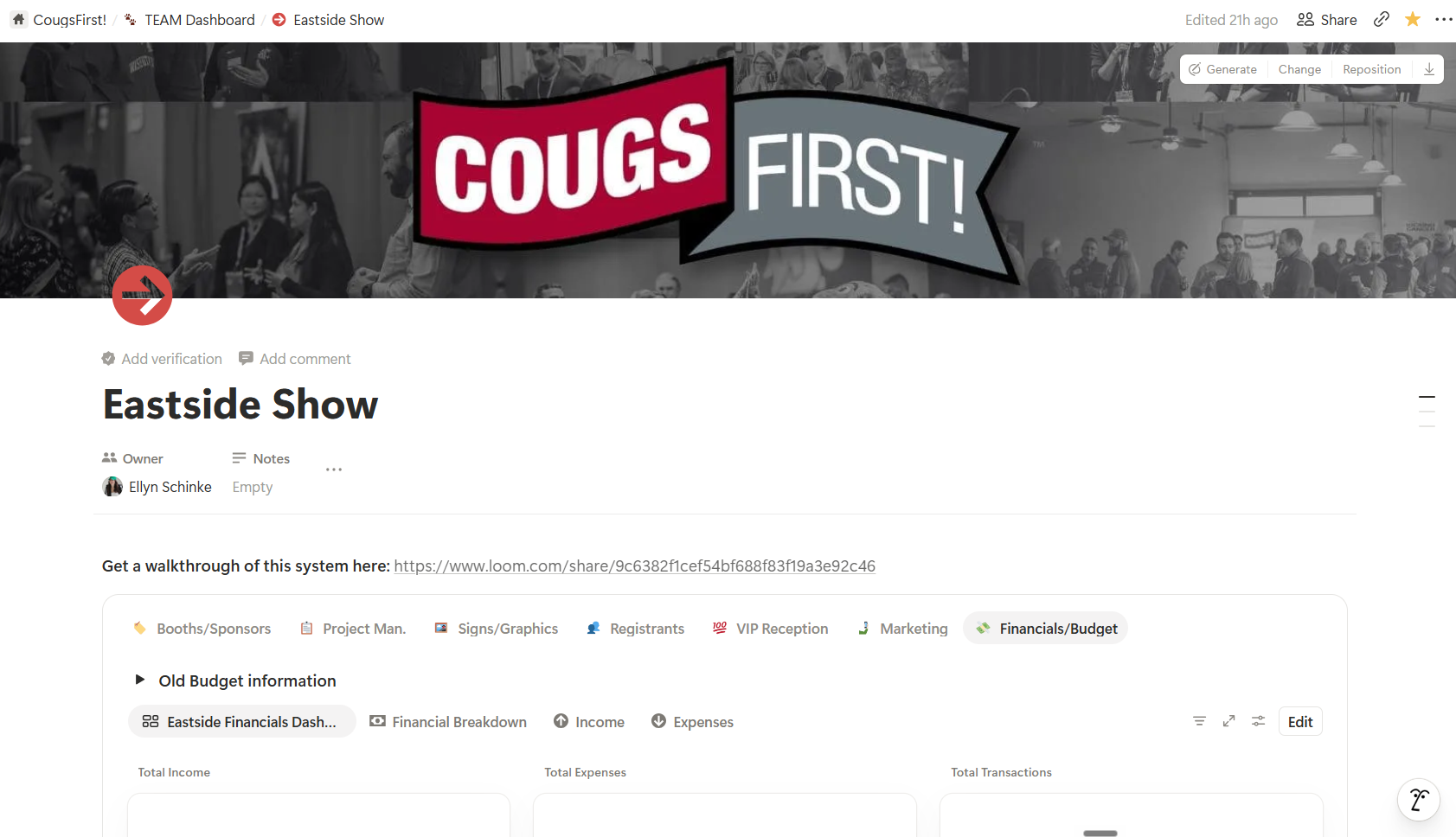
Events, operations, and marketing needed the same information for different reasons. The events contractor needed to sort and filter booth information, including finding gaps. Operations needed files and design details to be findable. Marketing needed to know which sponsor was owed which placement, and have the logo, links, and social handles to deliver it.
We went through the existing event spreadsheet tab by tab. Booths. Sponsors. Project tasks. Speaker and AV requirements. Signs and graphics. Volunteers. Day-of schedules. Delivery details. Budget references.
The choices were practical. Some information needed connected records. Some needed a simple table. The day-of schedule needed to be easy to print, not turned into a complicated task workflow just because we could.
We also kept continuity in mind. Events already underway stayed in their existing systems. The East Side Show became the Notion build intended to provide a foundation for future events, with the next year’s West Side Show and QB Classic in the roadmap.
The East Side Show workspace has been built, with sponsor and booth refinements continuing as the November event approaches. The real-world event cycle is the next opportunity to see where the system holds up and what still needs adjusting.
The bigger picture started showing up
As the relationship continued, the questions expanded beyond task management.
We worked through financial visibility: how payments should connect to businesses and events, what projected versus actual figures needed to show, and how income and expenses could be organized for event-level reporting.
We explored and tested a receipt-processing workflow involving Google Drive and Zapier. We also worked on AI instructions shaped around CougsFirst!’s business and brand, while developing a separate proposal-processing skill to turn signed commitments into linked tasks.
But not every gap could be fixed by adding something inside Notion.
GrowthZone, the organization’s member-management platform, was part of the wider picture. The team was dealing with constraints around directory search, registration, sponsorship processing, and integrations. Some planned connections required access their current subscription didn’t include.
We revisited those decisions instead of assuming the original integration plan was still the right one. By September, we were discussing whether more workarounds and upgrades were worth it if the organization might eventually leave the platform.
That’s where the engagement became especially strategic. Not just “Can we connect these tools?” but “What are we building around, and will it still make sense next year?”
What comes next: a member experience built around CougsFirst!
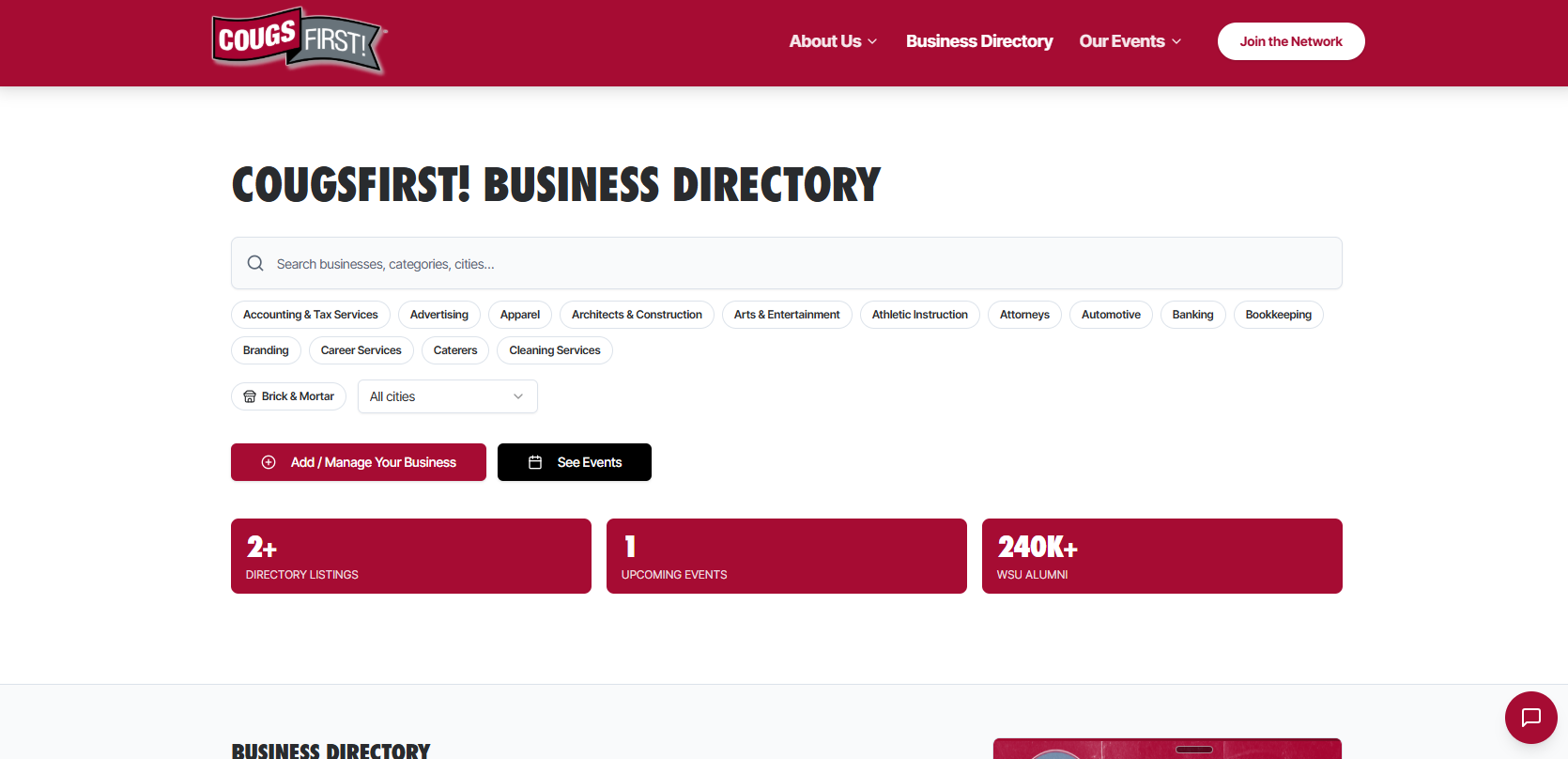
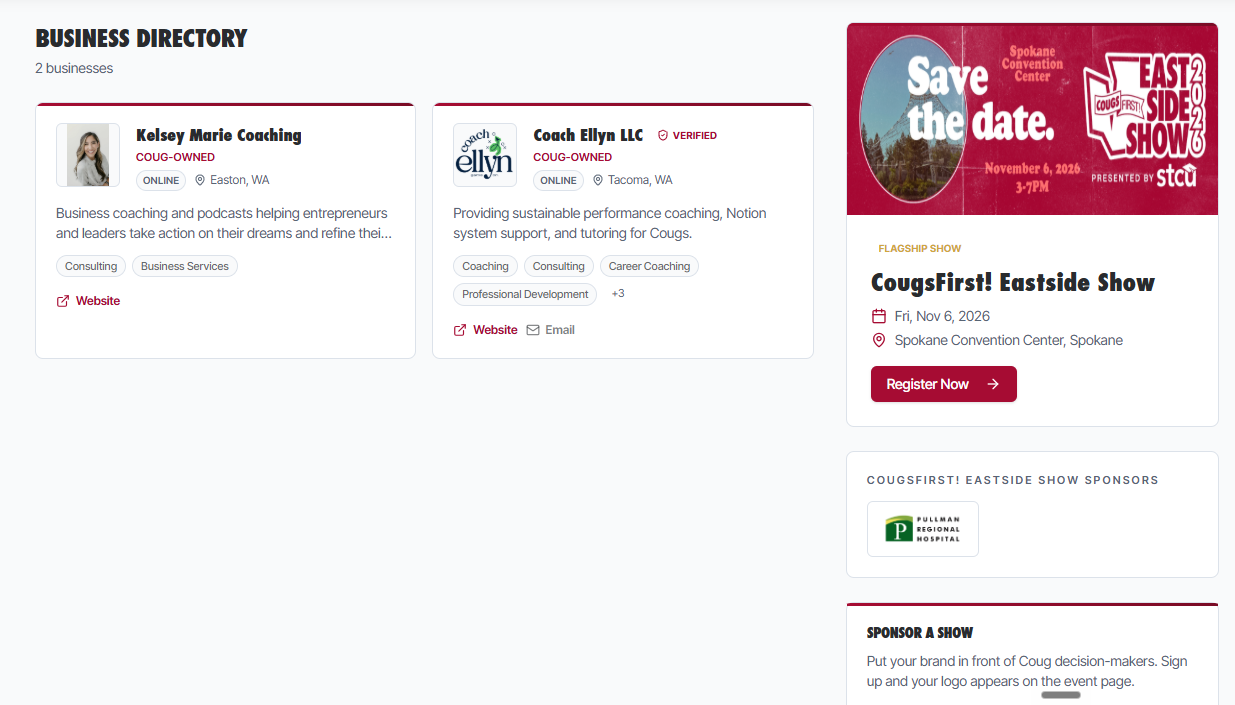
That question led to a prototype of a custom member and event platform in Base44.
In a September working session, we explored a different directory search experience, business profiles, event registration, and sponsorship information connected to the Notion backend. Kelsey could see possibilities that had been difficult to achieve in the current setup.
The same pattern from the beginning was there again. Seeing the experience made the possibilities concrete.
We’re now considering a proposed expansion that would take that prototype into a tested member-facing platform: accounts and profiles, directory search, event and sponsorship pathways, payments, and the operational connections behind them.
The proposed transition target is ahead of the June 2027 GrowthZone renewal. Requirements, permissions, migration, testing, training, and ongoing support all need to be addressed deliberately. This is the next chapter being scoped, not a platform already launched.
What makes it possible to have that conversation is the context built over months of working together. The questions are rooted in the organization’s actual workflows, not a generic list of software features.
More than a Notion build
Since our first consultation in late 2025, this work has grown from improving an initial workspace into a continuing partnership around how CougsFirst! operates.
There’s now a connected foundation for partnerships, sponsorships, deliverables, board collaboration, meeting follow-through, and team tasks. There’s an East Side Show workspace, tailored views and training, and a clearer direction for the infrastructure still ahead.
The work hasn’t been one straight line from messy spreadsheet to perfect dashboard. We’ve built, simplified, taught, tested, and changed direction when the operational reality called for it.
That’s what this story is really about. Understanding the organization well enough to help its systems evolve with it, without asking the people running it to keep making up the difference.