Crimes Against Ambition
I have this quiet belief that if I do not do it the hardest way, I am cheating.
I do not say that out loud very often because it sounds ridiculous once it leaves my body. But it is there.
If I need help, I cheated.
If I use the shortcut, I cheated.
If I rest before collapse, I cheated.
If I let the system support me instead of white-knuckling every single step myself, I cheated.
If I lose weight without suffering enough, I cheated.
If I build the business with AI, templates, coaching, structure, support, automation, medication, ease, or any tool that makes the mountain less miserable to climb, some ancient little prosecutor in my head stands up and says: Objection. Insufficient suffering.
And apparently, somewhere along the way, ambition became less about what I wanted to build and more about how much I was willing to endure before I let myself have it.
So fine. Let’s call the court to order.
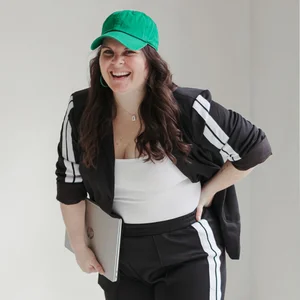
The court calls Ellyn Schinke to the stand. Charged with crimes against ambition.
Not because I did not want enough. Never. That has never been the crime.
The crime was wanting the life and then making it wait for a more acceptable version of me to arrive.
The crime was calling it timing when it was fear with better branding.
The crime was calling it discipline when it was punishment with a planner.
The crime was calling it strategy when I was really trying to build a case against my own desire.
The crime was believing ambition had a moral code.
And that somewhere in the fine print, it said: You may want the thing. But only if you bleed correctly.
Here are the charges against me.
3 Counts of “Resting before I earned it, not working all the time, and choosing peace over performance.”
The prosecution would like to enter into evidence the week I barely worked. The meetings I attended only because they were already on my calendar. The hours I spent playing solitaire on my phone. The YouTube reruns. Say Yes to the Dress. Deadliest Catch. Bondi Beach Rescue.
It would also like to enter the walk that stayed a walk. The night I did not post. The idea I did not immediately package. The quiet that did not become content. The window of time I could have used better.
Look at her, the prosecution says. Resting. Avoiding. Wasting time. Claiming she wants big things and then behaving like a woman with a nervous system.
Your honor, the defendant says she was tired. The prosecution argues she had not earned tired.
Which is the part I hate admitting. I do not experience rest as neutral. I experience rest as suspicious. If I have not finished the thing, rest feels like theft. If I am not at the fantasy yet, rest feels premature. If the business is not where I want it to be, rest feels like a reward I am trying to cash in before I have enough points.
And the wild thing is, I know better. I know rest is not optional. I know bodies collect the debt the calendar refuses to acknowledge. I know chronic stress eventually takes the exact things I need most: executive function, emotional regulation, working memory, strategic thinking, and the ability to look at my business without wanting to crawl out of my skin.
I know all of that. And still, when my body finally stops, some part of me wants to cross-examine it.
Where were you on the afternoon of August 6th? How many videos did you watch? How many tasks did you avoid? Did you or did you not claim to be ambitious?
This is where peace gets dragged into the courtroom too, because peace has terrible optics. Peace does not screenshot well. Peace does not produce enough proof. Peace lets a walk stay a walk, which ambition finds personally offensive.
I go on a walk for mental recovery, and suddenly I am voice-dictating three content ideas into AI. I make space to be quiet, and some part of me starts organizing the quiet into a framework. I sit down to breathe, and within thirty seconds I am evaluating whether the breathing is working.
Is this regulating me? Is this useful? Is this something I can teach? Is this content? Is this proof?
That is not peace. That is performance wearing athleisure.
And I hate that because content is one of my favorite parts of my business. Writing essays, newsletters, the big raw pieces that feel like I am pulling a thread from my own chest and somehow finding other women attached to the other end. I love that. I love this. But loving the work does not mean every moment of my life has to become material for the work.
I plead guilty. I rested before ambition gave permission. I did not work all the time. I chose peace over performance, or at least I am trying to.
Guilty as charged, your honor.
I apologize.
It will absolutely not happen again.
Which is, of course, a lie.
2 Counts of “Taking the easier way and needing help.”
The evidence against me is embarrassing in its simplicity: I used the tool. I took the support. I let the path be less miserable than ambition wanted it to be.
Every shortcut left ambition clutching its pearls because the result started to look less earned. Every time I let AI help me think faster, write better, organize the mess, or hold the fourteen open loops ricocheting around my skull at 2:00 in the morning, ambition acted like I had personally insulted the institution of discipline.
Ambition had expected the hard way. The six-day-a-week, ninety-minutes-a-day workout plan. The meal prep. The discipline montage. The body transformation with no outside help, no medication, no suspiciously effective support, no easy way out.
So yes, ambition may approve of the fact that I have not taken a GLP-1. But it is deeply offended that I also have not become the kind of woman who works out six days a week for ninety minutes a day and eats like a wellness influencer with a produce sponsorship.
That is the contradiction. Ambition is not merely anti-shortcut. Ambition is offended by anything that reveals I might need support.
The tool offends it because the tool makes the mountain less miserable. The medication offends it because the medication makes the result less punishing. The system offends it because the system means I do not have to manually drag myself across the finish line by my fingernails.
Suffering, on the other hand, ambition understands. Suffering is clean evidence. Suffering takes the stand well.
And that is the part I hate admitting. It is not really about AI. It is not really about GLP-1s. It is not really about the template, the coach, the VA, the community, the deadline, the body double, the therapist, or the AI chat that knows too much because I have been speaking into it on walks like it is a confession booth with Wi-Fi.
It is about the morality I have attached to difficulty.
Somewhere in me, the harder path became the more honest path. Like I have to hold up the thing I built and say: do not worry. I paid for this in exhaustion. No one handed it to me. No one helped too much. No tool made it too easy. No system caught me before I fell. I walked uphill both ways in the snow, a sports bra and a shame spiral, so you can trust that I deserve it.
I know how ridiculous that sounds. I also know how many high-achieving women are running some version of that operating system. We do not just want the result. We want the result to be admissible in court.
The cruelest part is that needing help feels especially damning when your identity has been built around being capable. Wanting help can still sound elegant. Strategic. Empowered. Needing help sounds like the mask slipped.
And if you are a solopreneur, especially one whose business began as proof that you could figure things out, needing help can feel like a contradiction. I started this because I could trust myself. I started this because I had ideas. I started this because I wanted autonomy. I started this because I did not want to ask permission from someone else’s systems.
And then the business becomes large enough, complex enough, emotionally expensive enough, that self-reliance stops being noble and starts becoming a single point of failure.
But even then, help feels loaded. All of it circling the same quiet indictment: shouldn’t you be able to do this yourself?
That question sounds responsible. It sounds mature. It sounds like accountability. But sometimes, “I should be able to do this myself” is not accountability. Sometimes it is isolation with better branding. Sometimes it is the founding mythology of the business turning into a cage.
Support is not the opposite of ambition. Support is what makes ambition less dependent on my best-case self.
I plead guilty. I used the tool. I took the support. I needed help.
The defendant pleads guilty.
Remorseful?
Not especially.
1 Count of “Being a beginner.”
The prosecution would like to cross-examine my qualifications.
Did you know what you were doing? Had you done it before? Can you prove you are good at it yet? Can you guarantee this will work? Can you explain why you are this uncomfortable if you are supposedly meant for it?
Ambition feels slandered by beginnerhood. It prefers competence. It prefers proof. It prefers the part of the story where I am already good.
I hate being bad at things. I wish I had a more charming way to say that. I do not.
I hate the exposed feeling of not knowing what I am doing. I hate the gap between my taste and my current ability. I hate seeing the vision before I have the skill to make it real.
And that is a problem because ambition requires beginnerhood. Not once. Repeatedly. Every new level asks me to become new again. New offer. New audience. New platform. New system. New identity. New relationship to money. New relationship to rest. New relationship to visibility.
I would like to formally object.
Because I want the competence without the reps. I want the confidence without the part where confidence has no evidence yet. I want to be brave in a way that does not make me feel stupid.
But that is not how this works. Beginnerhood is not evidence against ambition. It is the entry fee.
I plead guilty. I was new. I was bad at it in public. I mistook the discomfort of learning for proof that I did not belong.
I apologize to ambition for the embarrassment.
I will be embarrassing again.
2 Counts of “Choosing sustainability over spectacle and having a body.”
The prosecution objects on the grounds of insufficient drama.
Where is the sprint? Where is the public declaration? Where is the big dramatic reset? Where is the visible proof that you are trying hard enough?
Ambition understands spectacle. Spectacle is legible. Spectacle has receipts. Spectacle lets the world see the effort.
Sustainability, unfortunately for the prosecution, often looks like nothing dramatic happened because the system worked. Ambition finds that offensive.
Sustainability looks like the same thing working on an unsexy Tuesday. It looks like fewer decisions. It looks like defaults. It looks like making the good choice less heroic. It looks like building a business that does not require me to be fully caffeinated, fully motivated, fully regulated, fully inspired, and fully available for the system to function.
The research brain in me loves this because the evidence is clear. High self-control people are not spending their days heroically resisting temptation. They structure their lives so they encounter fewer temptations in the first place. Systems beat willpower not because humans are weak, but because humans are human.
But the high achiever in me still wants the heroic version. The one where I overcome. The one where I can say, look how hard I fought.
Sustainability asks a different question: what if it did not have to be a fight every time?
Which brings us to the body.
The prosecution would like to cross-examine it too. Can you confirm you needed sleep? Can you confirm you experienced hunger? Can you confirm your hormones did not check the launch calendar before becoming inconvenient? Can you confirm you failed to operate like a frictionless productivity machine?
Ambition feels wronged by the body’s needs. It has required food. It has required rest. It has required recovery. It has had the audacity to change, fluctuate, swell, ache, fog, crash, and refuse to operate like a SaaS dashboard with a nervous system add-on.
A body that sometimes takes the stand and says: I have been objecting for months. She overruled me. We are done here.
This is where the performance world has done such a number on us. The five a.m. routine. The fasted workout. The ideal worker availability. The assumption that output is just a function of discipline and time. The fantasy that your biology is a variable you can out-strategize if you are committed enough.
And then women, founders, mothers, neurodivergent people, high-capacity humans with actual nervous systems try to run themselves through that machine and conclude they are the problem when the machine was never calibrated for them.
The office was too cold. The research was too male. The workday was too uninterrupted. The body was too inconvenient.
And somehow the conclusion became: try harder.
I plead guilty. I chose the system over the sprint. I built something boring enough to hold me. I had a body and stopped treating that as a character defect.
Guilty.
The body rests its case.
1 Count of “Wanting the life to feel good.”
The prosecution would like to know: on what grounds does the defendant request pleasure before completion?
Ambition is not opposed to pleasure. It simply prefers to keep pleasure in escrow.
After the milestone, fine. After the revenue goal, fine. After the body changes. After the offer works. After the systems are clean. After the proof is undeniable.
This might be the most dangerous charge, because plenty of people will tolerate your ambition if the ambition looks sufficiently punishing. They will respect the grind. They will admire the sacrifice. They will understand if you are exhausted because exhaustion is a socially acceptable alibi for wanting more.
But wanting the life to feel good while you are still building it?
That sounds suspicious. Entitled. Premature.
But what if the life is not the reward? What if the life is the point?
What if the business is not a courtroom where I prove I deserve rest, pleasure, ease, support, softness, space, money, confidence, a body I am not at war with, a calendar I do not resent, and work I actually want to wake up to?
What if the business is supposed to be one of the structures that helps me live, not a machine I keep feeding with my own aliveness?
I do not want ambition that requires me to disappear from my own life. I do not want to become impressive at the cost of becoming unreachable to myself.
I want the life.
Not just the achievement.
I plead guilty. I wanted success to feel good. Not someday. Now.
Guilty as charged.
Because I am done asking pleasure to wait in the hallway until ambition is finished speaking.
Closing argument
Members of the jury, the prosecution has made its case.
It has shown you the week I rested. The tools I used. The support I needed. The hours I did not work. The walks I did not monetize. The systems I built so I would not have to keep proving my seriousness through exhaustion. The beginner reps. The inconvenient body. The unfinished business. The unfinished dream. The unfinished woman who dared to ask whether the life could feel good before the final verdict came in.
And the prosecution is right about one thing.
I did all of it.
On those counts, I plead guilty.
But I reject the sentence.
Because the prosecution has mistaken humanity for evidence. It has treated recovery like laziness, support like dependency, ease like fraud, peace like a lack of hunger, and the body like hostile testimony. It has treated a woman trying to build something sustainable as if she has personally offended the institution of wanting more.
And I am asking the court to consider another possibility.
Maybe the crime was not the week I rested. Maybe the crime was every year I believed rest had to be justified.
Maybe the crime was not needing support. Maybe the crime was making support prove it was not cheating before I let it help me.
Maybe the crime was not wanting ease. Maybe the crime was believing ease made the outcome less mine.
Maybe these were never crimes against ambition. Maybe they were crimes against the version of ambition that was committing crimes against me.
So no, I am not asking to be acquitted. I am asking for a new precedent.
One where support counts. One where rest counts. One where peace counts. One where the body is not hostile evidence. One where beginnerhood is not humiliation. One where sustainability is not a consolation prize for women who could not hack the grind. One where wanting the life to feel good is not proof that I want it less.
I still want big things. That was never the question.
The question is whether I am willing to keep turning every quiet hour, every imperfect week, every need for help, every shortcut, every body signal into a self-administered cross-examination.
And I am not.
The defense rests.