When Your Business Is Working, But Still Feels Wrong
Listen on Spotify // Listen on Apple Podcasts
When Your Business Is Working, But Still Feels Wrong
Your business can be working and still feel wrong.
Not broken.
Not doomed.
Not “throw the laptop into the ocean and start a new life selling sourdough starter on Facebook Marketplace” wrong.
Just wrong in that quieter, more irritating way where everything makes sense on paper, but your body keeps whispering, babe... this is not the game.
People want the thing. Money is coming in. The offer converts. The system mostly works. You have proof that the business has legs.
And still, you feel resentful. Tired. Weirdly trapped inside your own good ideas.
That is the part high-achievers hate admitting. Because if the business is working, aren’t you supposed to be grateful? Yes.
Also, gratitude does not mean ignoring the scoreboard. And profit is not the whole scoreboard.
The most confusing business problems are the ones that technically work
When something is obviously broken, the problem is easier to name.
The offer is not selling. The system is a mess. The client process is leaking. The content is not connecting. Fine. Annoying, but clear.
The harder problem is when the business is technically working, but keeping it working requires you to become someone you do not want to keep becoming.
That is where founder burnout gets slippery.
Because the evidence looks positive.
Revenue says keep going.
Demand says keep going.
Attention says keep going.
Your calendar says keep going.
But your resentment is telling a different story.
You open your laptop and feel the tiny “ugh.” You get another “quick question” that is somehow never quick. You have a good idea and instead of feeling excited, it feels like another tab open in your nervous system.
That is not laziness. That is data.
Profit is not the whole scoreboard
Revenue proves demand.
It does not automatically prove alignment.
It does not prove sustainability.
It does not prove the founder is in the right position.
It does not prove the offer still belongs at the center.
It does not prove the business can hold the ambition without eating the person building it.
This is why “but it makes money” is not always the complete answer.
Money matters. Rent remains rude. But every dollar has a cost.
Some dollars feel clean. They come from work that stretches you in the right direction. They require effort, but the effort belongs. You can feel yourself becoming more of the person you want to be.
Other dollars technically count, but cost too much to collect.
They cost resentment.
They cost identity drift.
They cost decision fatigue.
They cost constant context switching.
They cost invisible cleanup.
They cost the low-grade feeling that your business is pulling you out of position.
That is what I mean by an emotionally expensive business.
What is an emotionally expensive business?
An emotionally expensive business is not necessarily failing. Sometimes it is very specifically succeeding.
It is the offer that sells, but drains you every time you deliver it.
The platform that gets attention, but keeps you known for the wrong thing.
The client process that technically works, but only because you keep absorbing the friction.
The content rhythm that creates visibility, but makes every idea feel like a threat.
The role people understand fastest, but that slowly becomes too small for the work you actually came here to do.
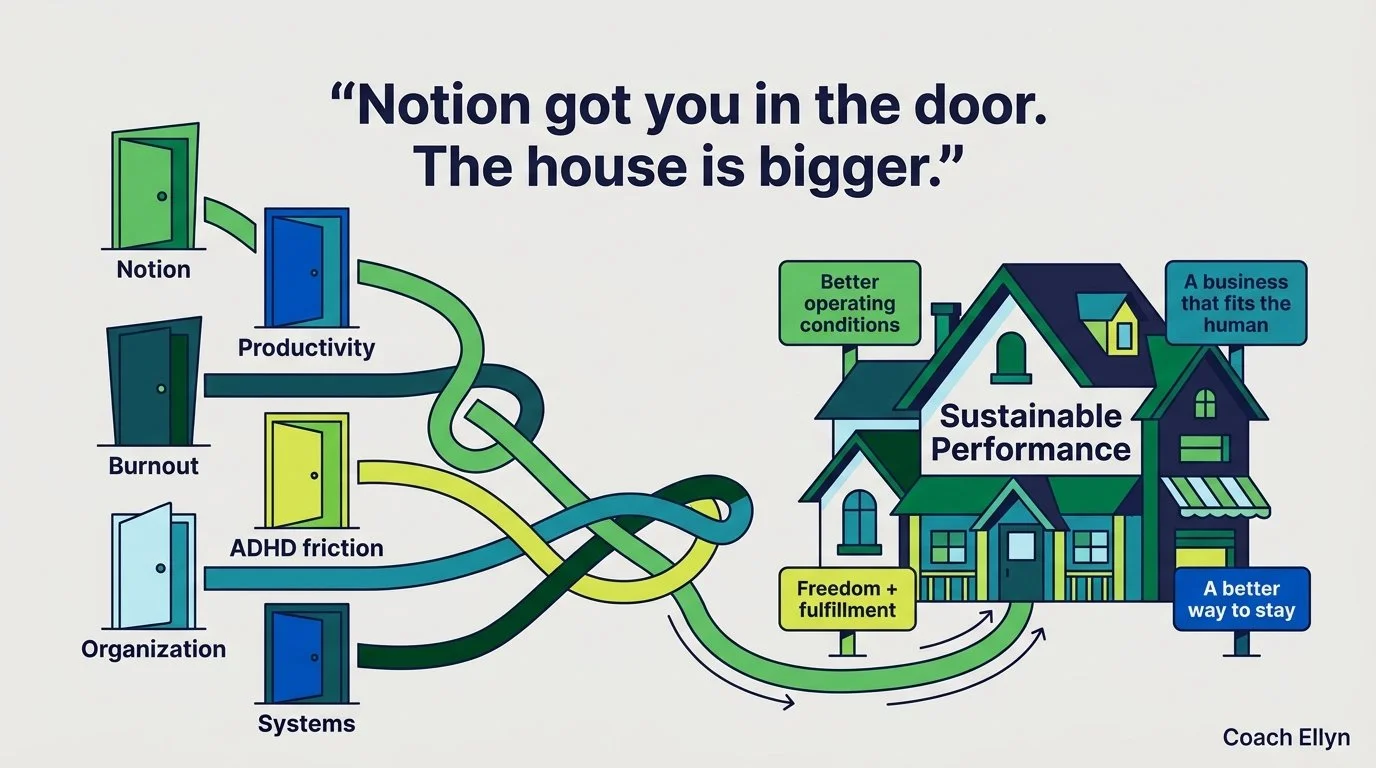
For me, this shows up in the “doors are not the whole house” problem.
Someone wants the Notion thing, so you make the Notion thing.
Someone wants the burnout thing, so you make the burnout thing.
Someone wants the productivity thing, so you make the productivity thing.
And none of those doors are wrong. The problem starts when one door becomes the whole house.
The thing people understand fastest about your work starts becoming the thing your entire business orbits around, even when it is not the full truth.
That is how you can lose the plot inside a business that technically works.
The hidden costs: resentment, identity drift, and idea fatigue
The emotional surcharge usually does not arrive as a dramatic breakdown. It arrives as pinpricks.
A tiny decision here.
A quick question there.
A client process that needs one more manual save.
A platform that keeps asking you to perform an old version of yourself.
A “smart” offer that makes sense on paper, but does not feel like the work anymore.
One pinprick is manageable. A hundred pinpricks becomes a business model.
That is when high-achievers start blaming themselves.
You tell yourself you should be grateful. You should stop overthinking. You should be more disciplined. You should just focus.
But sometimes resentment is game film.
Sometimes dread is game film.
Sometimes the “I should be grateful” spiral is game film.
Sometimes wanting out is not really wanting out.
Sometimes it means you want a better way to stay.
The Emotional Surcharge Audit
This is the audit I am running on myself right now. Pick one part of your business that technically works.
An offer. A platform. A client process. A content rhythm. A recurring task. A role people know you for.
Then ask: What does this cost me to keep running?
Not just in money.
In energy. In resentment. In cleanup. In context switching. In body tension. In decision fatigue. In tiny invisible “ugh” moments.
Then ask the question with teeth: If I were building this from who I am now, would I build it this way again?
Sometimes the answer is yes.
Sometimes the thing is hard because it matters. A business you love will still ask real work from you. That is not the problem.
The problem is misaligned expensive. The problem is when the current design keeps asking you to pay for an older version of the strategy. The problem is when the business only works if you keep abandoning the kind of work, rhythm, or role you actually want to grow into.
That is not a sign that you need to burn everything down. It is a sign that the business needs better game film.
You may not need out. You may need a better way to stay.
This is the reframe that matters.
A lot of founders wait until they hate the business before they give themselves permission to redesign it.
They wait until the resentment is loud enough to feel legitimate.
They wait until they are crispy.
They wait until good ideas stop feeling good.
They wait until “I should be grateful” has been running the meeting for months.
But “this is working, but not like this” is enough information to start.
You do not have to abandon the thing you love because the current version is too heavy.
You do not have to confuse proof with peace.
You do not have to keep playing a game just because you have gotten good at winning it.
You can read the scoreboard and the game film.
You can keep the ambition and change the conditions.
You can want a better way to stay.
Ready to redesign the part that keeps charging too much?
If your business is technically working, but the emotional surcharge is getting too high, that is not a character flaw.
That is a design problem.
Inside Season Pass, this is the kind of pattern we diagnose and redesign: the offers, systems, roles, and operating conditions underneath the business so your ambition has a place it can actually survive.
Not because you need saving.
Because your business should stop making you pay an emotional surcharge on your own ambition.
Check out this week’s Sunday CEO Diaries newsletter and start with one question: where is your business working, but not like this?