
The System Reset You Actually Need (No Overhaul Required)
Listen on Spotify / Apple Podcasts
I used to be the person who woke up on January 1st with my entire year mapped out. Goals color-coded, systems pristine, everything locked and loaded.
This year? I have no concrete goals. At least not in the way I used to.
And honestly? It feels calm. But also kind of unnerving.
Because here's what I've learned after years of building, breaking, and rebuilding my business systems: The problem was never the systems themselves. It was that I was treating them like monuments instead of organisms.
So if you're sitting here in January (or honestly, any time of year) feeling like your systems are broken and you need to start from scratch—stop. You don't need 47 new systems. You need one priority and one system to support it.
Today, I'm walking you through the exact 3-question framework I use to reset my systems without overhauling my entire life. Because sustainable systems aren't built in a day—they evolve.
Why New Year Momentum Isn't Toxic (When You Use It Right)
Okay, let's address the elephant in the room first: Is using New Year momentum just buying into toxic productivity culture?
Short answer: No. Not if you're doing it right.
There's actual behavior change research from psychologist Karin Norton that shows we have these built-in psychological moments of rebirth throughout the year. Fresh starts. Temporal landmarks, she calls them.
January 1st is one. Your birthday is another. The first day of a new season. Even Mondays, for some of us.
These moments create a mental separation between "old you" and "new you"—and that separation? It's powerful. It gives your brain permission to change.
So instead of fighting the momentum or pretending you're above it, use it. Harness it. Because trying to start a new habit on a random Thursday in March? That's just harder. And honestly, why make it harder than it needs to be?
The 3-Question System Reset Framework
Alright, here's the framework. Three questions. That's it.
Question 1: What's Actually Working Right Now?
Not what should be working. Not what works for someone else. What's working for you?
Maybe it's your morning routine. Maybe it's how you batch content. Maybe it's literally just one database in Notion that you actually update.
Here's the thing—write it down. Celebrate it. And whatever you do, don't touch it. If it's working, leave it alone.
I always recommend starting with the good stuff. The thing you can celebrate. The thing you can leverage as momentum. Because so often we get stuck in what's not working and feel like we have to reinvent our whole life.
We're not doing that here, friend.
Question 2: What Feels Cluttered or Overwhelming?
This is where you get honest. What are you avoiding? What makes you groan when you think about it?
Is it your task management system? Your content calendar? Your weekly review process? Your non-existent workout schedule?
For me, it was my weekly review. I'd built this elaborate system that required me to pull data from six different places, manually update three dashboards, and basically recreate the same information every single week.
No wonder I kept avoiding it, right?
This question reveals where friction exists in your current setup. And friction? That's what kills consistency.
Question 3: What Would Ease Look Like This Quarter?
Or flip it: What's creating friction right now?
This question is gold because it forces you to think about experience, not just outcomes.
Ease doesn't mean lazy. It means smooth. Efficient. Aligned with how your brain actually works.
For me, ease looked like less manual entry. Less redundant systems. More automation. More leveraging the systems I already had.
And here's the thing about us high achievers—we can get so fixated on outcomes that we forget to consider the experience. But if we can make the experience better? The outcomes will follow.
The One Priority, One System Approach
Here's where most people go wrong: They identify twelve things that need fixing and try to overhaul everything at once.
Don't do that. Seriously.
Pick one priority for this quarter. Just one. And then ask yourself: What's the one system that would support that priority?
That's it. One priority, one system.
Not 47 new systems. Not a complete digital detox and rebuild. Just one thing.
Because here's the truth: Your systems are organisms. They evolve. You're not going to get it perfect from the start—and that's okay.
You build it, you use it, you tweak it. Build, use, tweak. Build, use, tweak. That's how systems actually work in real life.
Your business is going to evolve and have new needs. You are going to evolve and have new needs. That's not just normal—that's how it should be.
Real Example: How I Simplified My Weekly Review
Let me show you what this looks like in practice.
My old weekly review was a disaster. I had a template with probably twenty prompts. I was pulling information from my task database, my content calendar, my client tracker, my revenue dashboard—you get the idea.
And every week, I was manually typing in things like "upcoming deadlines" and "top priorities"—even though that information already existed in my databases.
It was redundant. It was exhausting. And I stopped doing it consistently.
So here's what I did: I stripped it down.
I went back to the three questions I've been asking myself for 10 years: • What worked this week? • What didn't work? • What's the one priority for next week?
And then—this is the key—I embedded my actual task database and content calendar into the weekly review page.
So instead of recreating information, I was just looking at it. All in one place.
Suddenly, my weekly review took fifteen minutes instead of forty-five. And I actually started doing it again.
That's what simplification looks like. You're not removing value—you're removing friction.
The 6-Month Systems Tweak Calendar
Now, if you're sitting here thinking, "Okay, but I have like twelve systems that need attention"—I hear you. I really do.
Here's what you do: Space it out.
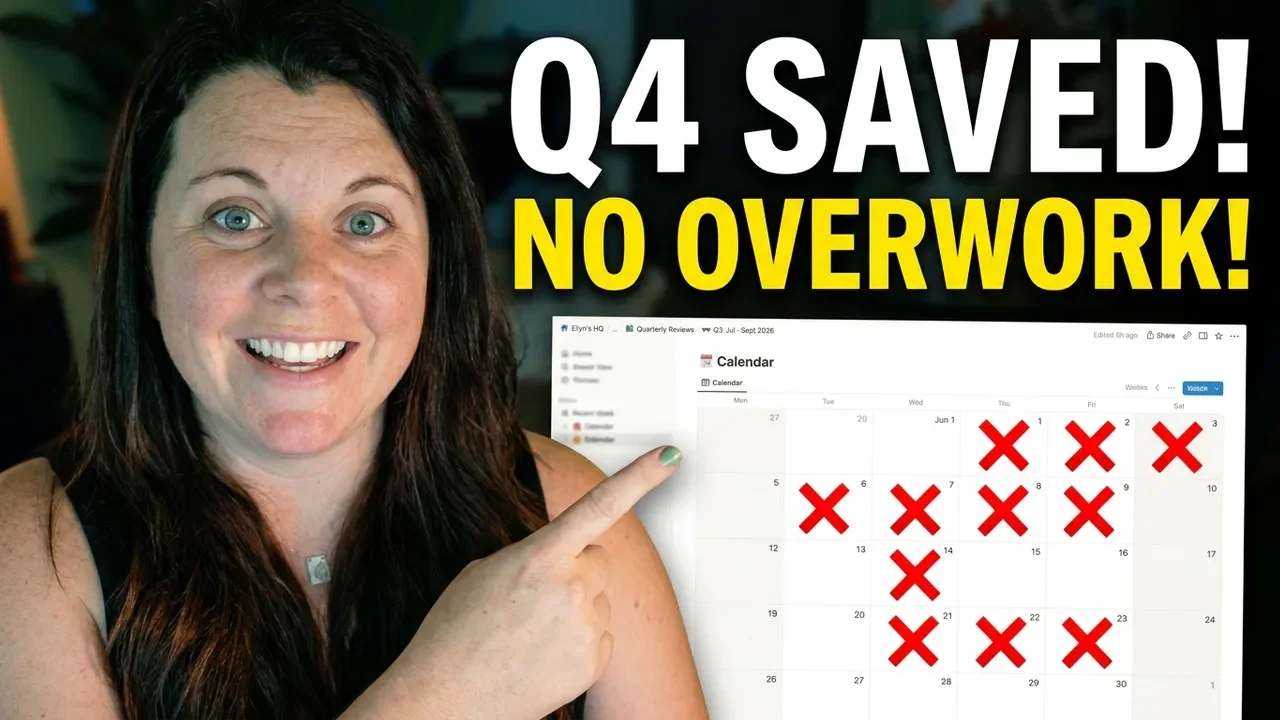
Make a six-month calendar. One systems update per week for the next six months.
Week 1: Simplify your weekly review. Week 2: Test your new weekly review. Week 3: Audit your weekly planning process. Week 4: Clean up your task database. Week 5: Audit your content calendar. Week 6: Automate one recurring task.
You get the idea.
You don't have to do it all at once. In fact, you shouldn't. Because system maintenance is not a one-time event—it's ongoing.
And when you space it out? It stops feeling overwhelming and starts feeling manageable.
Romanticize Your System Maintenance
Okay, last thing—and this might sound silly, but I promise it works.
Romanticize your system maintenance.
Light a candle. Pour some wine. Put on your favorite playlist.
Make it something you look forward to, not just another task on your to-do list.
Because if your systems feel like drudgery, you're not going to maintain them. But if they feel like this sacred, cozy, "this is my zone" kind of moment? You'll actually do it.
And that's what makes systems sustainable.
This is one of the biggest reasons my weekly review has stuck around for 10 years. I've made it something I genuinely enjoy doing. It's not just another obligation—it's a ritual.
Here's What I Want You to Remember
You don't have to do it all now. You don't have to overhaul everything.
Your systems are organisms—they evolve. And just because you notice something needs to be changed doesn't mean you need to act on it today.
Think of this like Marie Kondo for your digital workspace. You're auditing, you're purging, you're simplifying—not overhauling.
One priority. One system. That's where the magic happens.
System maintenance isn't about perfection. It's about evolution. It's about making small, strategic tweaks that compound over time.
So start with those three questions. Pick your one priority. Build your one system. And give yourself permission to take it slow.
Because the best systems aren't built in a day—they're built one intentional tweak at a time.
Ready to build systems that actually work with your brain? Take the Burnout Quiz to discover your burnout style and get personalized strategies for sustainable success.
Want weekly burnout-proof strategies? Subscribe to the Sunday CEO Diaries for systems, self-care, and mindset tips delivered straight to your inbox every Sunday.

You Built the System. Why Aren’t You Using It? My Biggest Takeaway from the Notion Ambassador Summit