
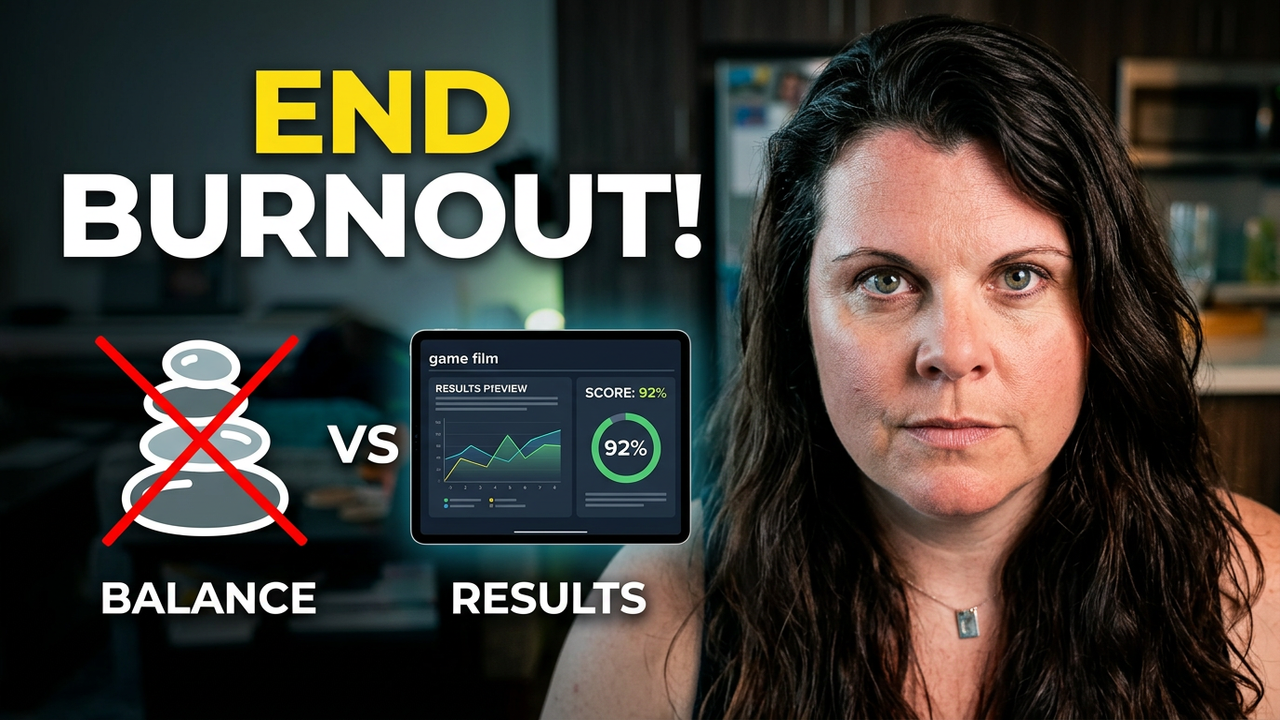
“Just Find Balance” Is Lazy Advice: Why It Doesn’t Work for Burnout
If someone tells you “just find balance,” what they’re really saying is: I don’t know how to help you.
Because balance advice isn’t a strategy. It’s a shrug.
And I need you to hear this clearly: it’s not just bad advice — it’s lazy advice.
Especially if you’re a high performer. Because for you, “balance” usually translates into an impossible expectation: split yourself in half until both halves resent you.
Here’s the trap.
You feel burned out, so you go looking for support.
And people hand you the same beige, copy‑paste, wellness-culture one-liners:
“Just find balance.”
“Just set boundaries.”
“Just take care of yourself.”
Meanwhile your calendar is on fire. Your brain is running 37 tabs. Your body is sending push notifications you keep swiping away. And somehow you walk away thinking: cool, so I’m failing at balance too.
That’s why this particular flavor of balance advice is so toxic: it turns a complex human problem into a simple you problem.
Balance advice collapses for one reason: it skips diagnosis.
It acts like burnout has one cause.
It doesn’t.
Burnout has types (and balance advice assumes only one)
When someone hears “I’m burned out” and immediately says “find balance,” they’re usually assuming it’s a volume issue. Too much on your plate. Too many hours.
But burnout can be:
Overwhelm / volume burnout: too much demand, too many roles.
Emotional burnout: the work is “fine,” but the emotional labor is relentless.
Physical burnout: sleep debt, stress load, illness, depletion.
Boredout: you’re “fine” on paper but dead inside — no challenge, no meaning, no stimulation.
So when balance advice skips diagnosis, you end up applying the wrong fix — and then blaming yourself when it doesn’t work.
4 reasons balance advice collapses in real life
01. It treats your life like a math problem
As if you can redistribute hours evenly and magically feel okay.
But you don’t live on a spreadsheet. You live in a body. You live in seasons. You live in real life.
Do the math for five seconds:
Sleep (let’s say 7 hours)
Work (8.5–9 hours)
Commute, food, laundry, relationships, health, admin, the basic maintenance of being a human
Your day is not “balanced.” It’s packed.
And if you’re an entrepreneur? Congrats — you traded a 9–5 for 24/7 with better branding.
02. It turns burnout into a personal failing
You’re tired… and now you’re also convinced you’re doing something wrong.
If you’re running too much volume, too much intensity, and not enough recovery, that isn’t a personality defect.
That’s load mismanagement.
And “be better at balance” is not a plan.
03. It dumps responsibility on you without giving you a framework
This is the biggest reason it’s lazy.
Because “find balance” doesn’t tell you what to do.
It quietly assumes you’ll be self-aware enough to:
identify where you’re “out of balance”
define what “balance” even looks like in this season
implement it in a way that’s feasible (and doesn’t set you up to fail)
notice when it stops working… and redesign the whole thing again
That’s not advice.
That’s homework with no rubric.
04. The pursuit of balance is a contradiction
The messaging is contradictory on purpose.
You’ll hear:
“all work and no play makes you a dull person”
…and in the same breath:
“be stable”
“pay your bills”
“save for retirement”
“be responsible”
So which is it?
Work less… or work more? Want big goals… but don’t be “too intense”?
That’s why balance advice feels like a trap. It’s conflicting cultural noise disguised as wisdom.
Imagine what changes when you stop treating “balance” like the goal and start treating it like a symptom.
When you stop asking:
“How do I get balanced?”
…and start asking:
“What type of burnout am I actually dealing with?”
“What’s my load right now (volume, intensity, recovery)?”
“Where am I relying on willpower instead of structure?”
Because your ambition isn’t the problem.
The lack of a playbook is.
You don’t need a softer life. You need a smarter system — one that can expand and contract without breaking you.
If this hit you in the gut, don’t go “self-care” yourself into another week of white-knuckling.
Do one thing:
Listen to the full episode:“Just find balance” is lazy advice (above)
(And then grab the teaching follow-up: Season Strategy — Stop chasing balance. Manage load.) Stay relentless, achiever!

Overworking isn’t just a bad habit—it’s meeting a need (control, certainty, proof you’re still “enough”). Learn what actually replaces overworking so rest doesn’t feel unsafe: name the job overworking is doing, then build a small replacement that your nervous system will accept.