
Balance is lazy advice (and high achievers are paying the price)
If you’re a high achiever, you’ve heard the same recycled line a thousand times: “You just need better balance.”
Cool. Between client delivery, content, sales, life admin, and a nervous system that’s been running on adrenaline since 2017… what does “balance” even mean?
That’s the problem. “Balance” is vague enough to sound wise and useless enough to keep you stuck.
Because when life gets real, you don’t need a vibes-based suggestion. You need a plan.
Not “rest more.”
Not “set boundaries.”
Not “take a bath.”
You need load management and a strategy that matches your season.
This post is the replacement framework I teach: Season Strategy — a simple way to name your season, diagnose your load, and design your week accordingly so you can keep performing without burning out mid-season.
What you actually need instead of balance: Season Strategy
Balance implies symmetry.
Sustainable performance is about readiness.
Readiness means you can push when it’s time to push, you can recover when it’s time to recover, and you’re not surprised by your own exhaustion every Thursday.
Season Strategy gives you a way to stop “winging it” and start making choices on purpose.
Before you pick a season, pick what matters (values > vibes)
If you’re getting whiplash from contradictory expectations, you don’t need another productivity tip. You need a decision hierarchy.
Because this is the part “find balance” never gives you: your values choose the season. The season chooses the strategy.
Try this values pulse check:
What do I actually care about winning this season?
What am I willing to stop pretending I can also win right now?
That second question isn’t a failure. It’s leadership. It’s how you build a season that matches your real life instead of a fantasy calendar.
It’s five steps:
Name your season (Push / Build / Recover)
Diagnose your load (not your vibe)
Choose a simple scoreboard (3 metrics)
Build your weekly playbook (default + variations)
Do weekly film study (data, not shame)
Let’s break it down.
Step 1: Name your season (Push / Build / Recover)
You only get in trouble when you pretend you’re in one season while living in another.
Push Season
Push season is more output on purpose. Examples: a launch, a deadline, a sprint, a promotion cycle, a season of intense client work.
Push season isn’t “bad.” It’s powerful — if you don’t try to live there forever.
Build season
Build season is where your focus is systems, skills, and infrastructure. You’re still doing the work, but you’re building the structure that makes future pushes easier.
This is where you fix the backend that keeps sabotaging you.
Recovery season
Recovery season is reduced load + protected capacity.
Not “falling behind.”
Not “being lazy.”
Recovery is you rebuilding the athlete. Here’s the line that matters: If you don’t name the season, you accidentally live in Push season all year… and call it “ambition” when it’s actually a programming error.
Step 2: Diagnose your load (not your vibe)
Most people try to solve burnout with vibes:
“I should rest more.”
“I should set better boundaries.”
“I should do more self-care.”
Cool. But why are you burned out? Because the type of burnout you’re experiencing determines the solution. Treat the wrong type and you stay stuck.
Here’s a simple diagnostic rubric (think “types of overtraining”):
1) Boredout burnout (under-stimulated)
You’re not physically exhausted — you’re flatlined. Same drills. Same routine. No challenge. No meaning. This is “I’m fine, but I’m dead inside.”
2) Overwhelm burnout (too much volume)
Too many roles, too many tasks, too many open loops. The plate is objectively overloaded. Your life is a to-do list you can’t escape. Your to-do list might not even be massive, but the work is heavy: conflict, decision fatigue, pressure, high visibility, high responsibility.
3) Emotional burnout (resentment + carrying everyone)
People-pleasing. Identity pressure. Feeling responsible for everyone’s feelings. Living in “should.” The talent is still there. The will isn’t.
4) Physical burnout (body depletion)
Illness, pain, hormones, depletion, appetite changes, “my body is screaming and I’m ignoring it.”
Here’s why this matters: “Out of balance” usually assumes your problem is overwhelm.
That’s why it’s lazy advice — it misdiagnoses you.
Step 3: Choose a scoreboard (three metrics, max)
If you don’t track anything, your nervous system assumes you’re always behind. So instead of tracking everything (and weaponizing it), you’re going to pick three metrics for this season — one from each bucket:
Output (what ships), capacity (what keeps you stable), and infrastructure (what reduces future effort).
Examples:
Output: 1 podcast episode shipped weekly
Capacity: average 7.5+ hours sleep + 2 workouts + one true off block
Infrastructure: automate onboarding, clean up capture, delegate one recurring task
The goal is simple: you stop guessing. You start seeing what’s working.
Step 4: Build a weekly playbook (so you stop reinventing your life)
This is the part most people skip… and then they call it “balance problems.” A playbook is:
What you do
When you do it
What gets benched on purpose
What gets delegated on purpose
What happens when life punches you in the mouth on a Tuesday
Key line: If it’s not written down, it’s not a system. It’s a wish.
Start with four versions of your week
You don’t need 47 templates. You need a few that cover reality.
Default Week (your baseline)
Push Week (more output, tighter priorities)
Recovery Week (reduced load, protected capacity)
Chaos Week (sick, travel, family crisis, “everything broke”)
Add a bench list (your nervous system will thank you)
The bench list is the thing you stop pretending you can also win right now. Not forever. Just for this season.
Examples:
Optional meetings
Non-urgent projects
Extra content channels
“Nice to have” admin upgrades
Protect capacity like it’s part of the plan (because it is)
High performers love to treat capacity as optional. It’s not. If your plan requires you to act like a robot, it’s not a plan — it’s a burnout schedule with better fonts.
Step 5: Film study (weekly)
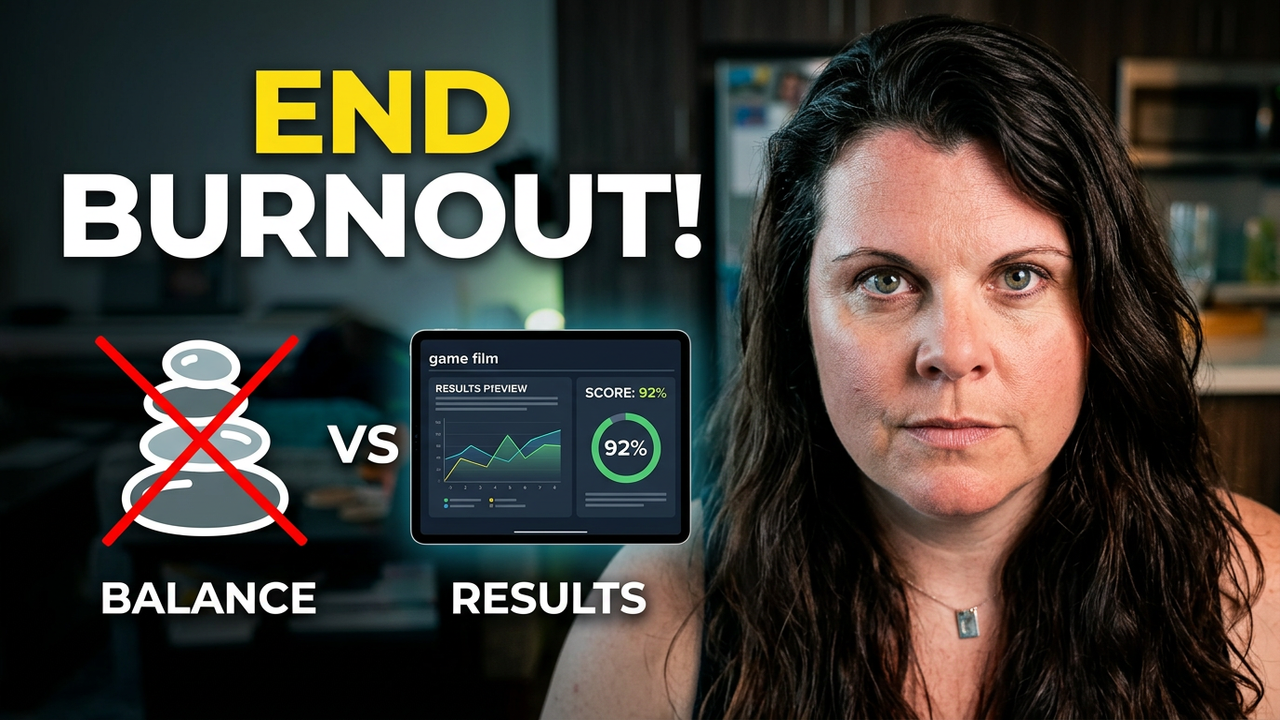
No shame. Just data. Once per week, you review the tape.
Ask:
What worked?
What broke?
What did I do that I should stop calling “normal”?
What’s the next play?
Broken plays are data, not identity. This is how you build self-awareness without turning your entire life into a self-improvement project.
Two quick examples (so you can apply this to your actual week)
Example A: You’re in Push season (launch, deadline, sprint)
What you do:
Pre-decide what gets benched
Protect recovery like it’s part of the launch plan
Simplify (food, workouts, admin) — don’t delete
Cut optional meetings and low-ROI tasks
Push season works when it’s intentional. It fails when it’s your default.
Example B: You’re in Recovery season (rebuild)
What you do:
Reduce load deliberately
Keep one primary output (so you don’t spiral)
Rebuild capacity (sleep, movement, downshift)
Stop apologizing for being human
Recovery season is not quitting. It’s training for longevity.
The bottom line
“Find balance” turns into homework with no rubric — and then you end up rebuilding your plan every time life changes.
Season Strategy gives you the rubric. Name the season. Diagnose the load. Choose the scoreboard. Build the playbook. Do film study.
You don’t need to be “more balanced.” You need to be more intentional.
Want help building your playbook (with your actual calendar)?
If you want help doing this with your actual capacity, your actual business model, and your actual calendar, join the free community here: https://coachellyn.com/community

Overworking isn’t just a bad habit—it’s meeting a need (control, certainty, proof you’re still “enough”). Learn what actually replaces overworking so rest doesn’t feel unsafe: name the job overworking is doing, then build a small replacement that your nervous system will accept.