
Are You Overwhelmed, Burned Out, or…Neither?
Listen on Spotify / Apple Podcasts
You Might Be Overtrained.
You keep calling it overwhelm. Your calendar is full, your brain is loud, your to-do list is reproducing like it pays rent, and no matter how many productivity hacks you try, you still end most weeks feeling like you got hit by a truck.
So you assume the problem is you.
That you are undisciplined. That you are “bad at time management.” That you just need to want it more. That maybe you are not cut out for this.
Cool story. Also, probably the wrong diagnosis.
Because what if you are not overwhelmed. What if you are overtrained? And what if that one word changes your entire treatment plan?
Overwhelm Makes You Feel Broken. Overtraining Makes You Fix the Program.
Here is what “overwhelm” does to a high achiever.
It turns a systems problem into a character flaw.
When you say “I’m overwhelmed,” it is easy to internalize it as, “I’m failing.” Like you are the only person who cannot handle what everyone else seems to juggle just fine.
Overtraining flips the script.
Athletes do not get to the end of a brutal training block and think, “I am weak.” A good coach looks at the data and says, “We overtrained you. The programming was wrong. Let’s fix the load.”
Same body. Same ambition. Different plan.
Burnout is not weakness. It is a recovery deficit.
Overtraining is not an accident. It is a programming error.
And if you are a coach, consultant, or service-based business owner, you are basically running a high-performance sport inside a business model that rarely comes with coaching, periodization, or recovery built in.
So you do what most founders do.
You sprint. Every day. Forever.
The Real Reason You Feel “Behind” All the Time
Most entrepreneurs are not doing too much. They are doing too much at the wrong intensity, for too long, with no recovery protocol. Let’s name what overtraining looks like in business.
1. No deload weeks
You do not have a built-in rhythm where the load drops on purpose. Every week is treated like a push week. Your brain is in output mode constantly. Even your “rest” is usually just guilt plus a laptop.
2. No off-season
You might take a vacation, but you do not have an actual season of lower intensity. Athletes have blocks. Competition windows. Recovery phases. Off-seasons. Founders have…a never-ending Wednesday.
3. Competition intensity disguised as “discipline”
You treat every Monday like game day. Every client deliverable is the championship. Every email, post, and launch feels like the Super Bowl. There is no low gear, so your nervous system never gets the signal that it is safe to recover.
4. You track revenue, but you do not track load
This one is the quiet killer. You track sales. You track followers. You track conversions.But you do not track what athletes track:
Volume: how much you are doing.
Intensity: how demanding it is.
Recovery: how much space you have between efforts.
So the three variables that determine whether you can sustain performance stay invisible. And invisible problems do not get solved.
You Would Never Train for a Marathon by Sprinting Every Day
If someone told you they were training for a half marathon by running 100 percent effort every day, you would not call them “motivated.”
You would call that a terrible plan. Because that plan ends one way. Injury.
And then months (sometimes years) of trying to recover something that never had to break in the first place.
That is what most founders are doing. Full sprint. Every day. No periodization. No deload. No recovery protocol. Just vibes and caffeine.
Then we call it overwhelm. It is not overwhelm. It is overtraining.
The Fix Is a Training Redesign, Not a Lifestyle Downgrade
This is the part where most advice goes off the rails.
Because if you are a high achiever, “do less” can feel like a slow death. It can feel inauthentic. Unfulfilling. Like you are shrinking to fit someone else’s nervous system.
That is not what we are doing here.
The fix is not to want less.
The fix is to build a training program that fits how you function. Because right now, many people are not running a program.
They are running a to-do list and a prayer. That is not a strategy. That is survival. Here is your athlete-style redesign.
The Athlete Reset: 4 Moves That Make Your Workload Sustainable
1. Choose seasons over symmetry
Stop trying to split your energy 50/50 across everything, all the time. That is not how performance works.
Athletes have:
Push seasons (high intensity and volume)
Competition windows (peak focus and output)
Recovery phases (lighter work, repair, rebuild)
Off-seasons (reflection, planning, lower stakes)
Your business needs the same structure. Not every week should feel the same. Not every month should carry the same load.
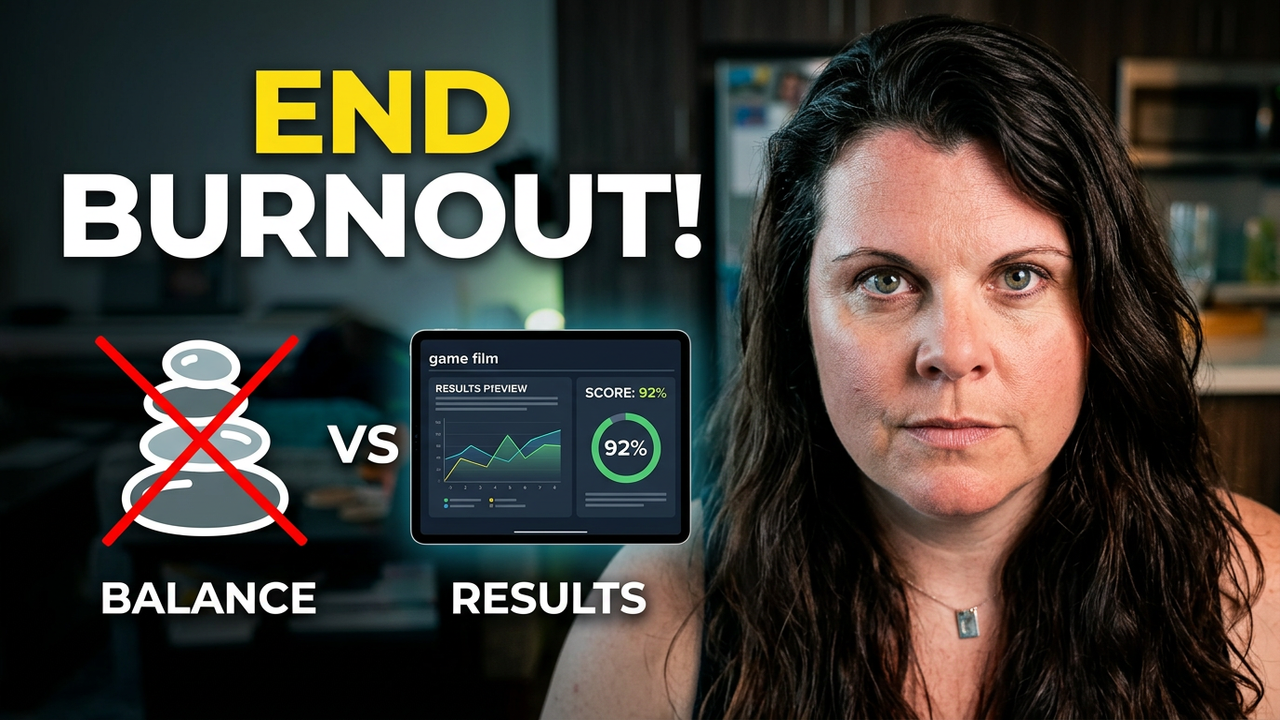
The goal is not balance. The goal is intentional seasons.
2. Track load, not just results
You cannot manage what you refuse to measure. Pick a simple weekly check-in and rate:
Volume: How many things did I ship?
Intensity: How emotionally or cognitively demanding was it?
Recovery: How much white space did I protect?
If your results are not changing, but your load is increasing, that is not a mindset problem. That is an unsustainable program.
3. Build deload weeks like a professional
A deload week is not a vacation. It is a structured reduction in load. Fewer calls. Fewer deliverables. Fewer decisions. More space.
In training, you do not ramp intensity forever.
You pull back so the next push actually has something to push with. If you do not schedule deloads, your body schedules them for you. It usually looks like brain fog, emotional reactivity, health issues, or a full shutdown.
4. Treat recovery like a protocol, not a reward
This is the line that changes everything.
You do not earn rest by burning out first. Recovery is what makes the next performance possible. It is not what you do after you break down.
It is what you build into the program so you do not break down. Your calendar should have recovery because you are a professional, not because you “deserved it.”
The Transformation: From White-Knuckling to Running a Business That Supports Your Life
Here is what changes when you stop calling yourself overwhelmed and start treating yourself like an athlete in a high-performance season.
You stop taking it personally. You stop trying to solve a systems problem with shame. You start designing your week like a training plan:
The hard days are hard on purpose.
The light days are light on purpose.
The recovery is non-negotiable.
Your ambition stays intact.
And the best part? You stop “surviving the season.” You start loving the game again.
Want the Playbook Instead of Another Pep Talk?
If this hit close to home, take that as a signal. It is not a coincidence. It is a diagnosis. And the good news is this: programming errors are fixable. If you want help rebuilding your training plan, start here:
Take The Burnout Quiz to get clarity on what is actually draining you: https://www.coachellyn.com/quiz
If you want the full systems-and-recovery overhaul, explore Burnout-Proof Business: https://www.coachellyn.com/bpb
If what you need is clean workflows and a Notion-backed operating system, check out Systems School: https://www.coachellyn.com/systems
You are not broken. You are overtrained. Let’s fix the program.


Most business coaching sells motivation and creates dependence. Learn the five red flags to watch for, plus what real coaching should deliver: diagnosis, decisions, a scoreboard, and growing independence.